
WE’RE SORRY
① KEEP CALM (ish) AND (don’t) CARRY ON
Take time to grieve and share your experience. Grief journeys are all different.
Saudade [soh-da-duh]
noun
A deep emotional state of melancholic longing for a person or thing that is absent.

② SIX NEEDS OF MOURNING
GRIEF, MOURNING, BEREAVEMENT - WHAT’S THE DIFF?
Grief is what we think and feel inside. Mourning is the outward expression of our grief. Bereavement is the period after a loss during which you experience grief.
Keening
[ˈkēniNG]
noun
The action of wailing in grief for a dead person.

③ KUBLER-ROSS’S 5 STAGES OF GRIEF
Stage 1 - Denial
Denial is the first of the five stages of grief. In this stage, the person operates in a state of shock and disbelief. "How could this happen to me?" and "I feel fine!" are common. We may fully understand the reality of the situation, but we're not ready to process it yet, and the denial period gives us a chance to take on only as much as we can handle at one time.
Stage 2 - Anger
Once denial begins to fade, anger commonly comes on its heels. Statements like "Why me?", "I don't deserve this!", and "It's not fair!" are very common, whether they're vocalized or internalized. It's a normal, necessary stage of the healing process, and it's often more acute when a death is a surprise, or seems unfairly quick. People tend to experience spiritual crises during this stage, as well, questioning God or other beings, depending on their beliefs.
Stage 3 - Bargaining
This stage hinges on the hope that a person can somehow delay or postpone a death by changing beliefs or behaviors. Usually, this negotiation occurs with a higher power, and sounds something like "If I just do XX differently, can you please give her more time?" This is also a stage where people can get mired in "If only" thoughts (e.g., "If only we'd found the tumor sooner..." or "If he'd just listened to me and gone to the doctor..." or "If I hadn't let her drive in this weather..."
Stage 4 - Depression
Depression is a very natural, normal response to experiencing loss, and in your work, you will see this at play both in your clients and in the people in their support networks. It's a necessary--sometimes long--step for most people, and when they are experiencing depression, it can feel endless and incredibly hopeless.
Stage 5 - Acceptance
Acceptance is often confused with being “all right with” what is or has happened. However, many people never feel all right with the situation. This stage is more about accepting a new reality and processing what that will mean for the person, his/her family, and anyone else involved.


④ ADD TO CART
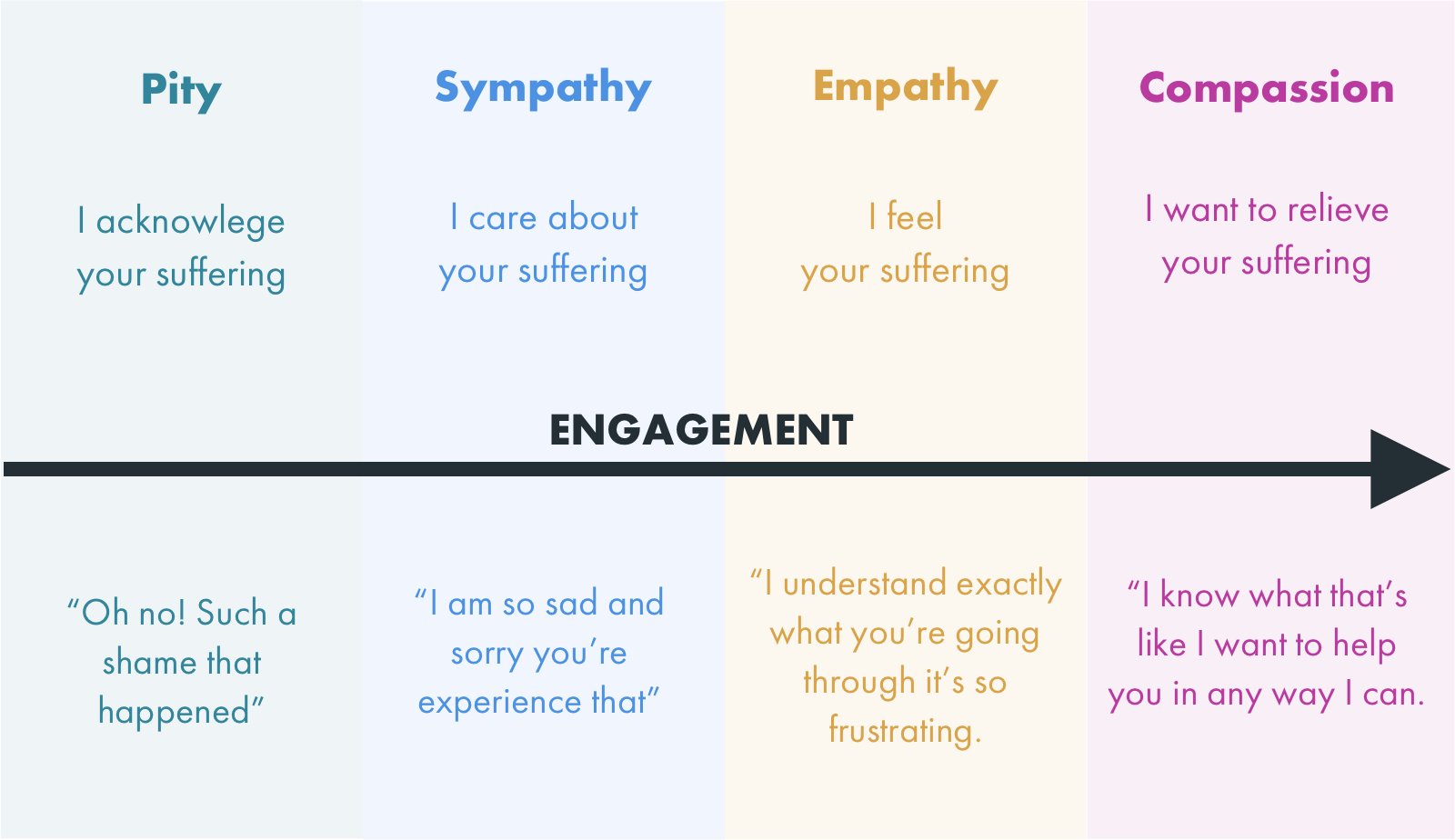
Compassion [kəmˈpaSHən]
verb
Feel the emotions of another person.
Understand the perspective of another person.
Combine #1 and #2 with a desire to help.
Help them without any of YOUR BULLSHIT©.
USES
All the time, everyday. But most important when someone is grieving.
via ted talks
PRO TIPS FOR THE GRIEVING
LISTEN
Avoid offering advice. Instead, listen to what your friend needs. “What is this like for you?”, “How are you doing today?”, “What do you want me to know about what you are going through?” are some ways to start listening.
Learn to listen. Find out their goal
Do they want solutions or to vent?
Listen, speak and act from the heart.
BE THERE
Let your friend know that you are there for him or her. More important than what you say is the fact that you called, wrote, or showed up.
Be the friend who is still calling and checking in three months after the death.
Be a calm and loving presence.
If you don’t know what to say, don’t say anything. It is okay to sit quietly. To hold hands while they cry. Just being present while your friend grieves is incredibly powerful. Our culture teaches us to “fix” things, but grief isn’t something that needs to be fixed. Grief needs to be experienced, and being a quiet witness to that process is often the most supportive thing you can do.
BE ACCEPTING
Ask about and reflect feelings.
Do not minimize grief or rush the process
Allow for the complexity, ambiguity and differing expressions (or non-expressions) of grief.
No simple solutions.
There is no timetable for grief.
All feelings are allowed

-
I am so sorry for your loss.
I wish I had the right words, just know I care.
I don’t know how you feel, but I am here to help in any way I can.
I’m thinking about you, and here for you.
My favorite memory of your loved one is…
I am always just a phone call away
Give a hug instead of saying something
We all need help at times like this, I am here for you
I am usually up early or late, if you need to talk
Saying nothing, just be with the person
-
At least she lived a long life, many people die young
He is in a better place
She brought this on herself
There is a reason for everything
Aren’t you over him yet, he has been dead for awhile now
You can have another child still
She was such a good person God wanted her to be with him
I know how you feel
She did what she came here to do and it was her time to go
Be strong
-
Do simple things with regularity. Make a meal or a supportive phone call.
Be available as you are able.
Talk about your own losses when appropriate.
DO let your genuine concern and caring show.
DO be available to listen or to help with whatever else seems needed at the time.
DO say you are sorry about what happened and about their pain.
DO allow them to express as much unhappiness as they are feeling at the moment and are willing to share.
DO encourage them to be patient with themselves, not to expect too much of themselves and not to impose any “shoulds” on themselves.
DO allow them to talk about their loss as much and as often as they want to.
DO talk about the special, endearing qualities of the person they've lost.
-
DON'T let your own sense of helplessness keep you from reaching out.
DON'T avoid them because you are uncomfortable (being avoided by friends adds pain to an already painful experience).
DON'T say that you "know how they feel". (Unless you've experienced their loss yourself you probably don't know how they feel.)
DON'T say "you ought to be feeling better by now" or anything else that implies a judgment about their feelings.
DON'T tell them what they should feel or do.
DON'T change the subject when they mention their loss or their loved one.
DON'T avoid mentioning their loss out of fear of reminding them of their pain (You can be sure they haven't forgotten it.
DON'T try to find something positive (e.g. a moral lesson, closer family ties, etc.) about the loss.
DON'T point out “at least they have their other ...”
DON'T say they “can always have another ...”
DON'T suggest that they “should be grateful for their so-and-so...”
DON'T make any comments which in any way suggest that their loss was their fault (there will be enough feelings of doubt and guilt without any help from their friends).
BEREAVEMENT COMPANIONING IS ABOUT
honoring the spirit; it is not about focusing on the intellect.
curiosity; it is not about expertise.
learning from others; it is not about teaching them.
walking alongside; it is not about leading.
being still; it is not about frantic movement forward.
discovering the gifts of sacred silence; it is not about filling every painful moment with words.
listening with the heart; it is not about analyzing with the head.
bearing witness to the struggles of others; it is not about directing those struggles.
being present to another person's pain; it is not about taking away the pain.
respecting disorder and confusion; it is not about imposing order and logic.
going to the wilderness of the soul with another human being; it is not about thinking you are responsible for finding the way out.