

THEY DIED
Now What?!@#!!
-
Call 911
Do not touch or move the deceased.
The police will notify the Coroner who will remove and transport them to the Coroner’s office. They will determine the cause of death.
-
Call the hospice nurse.
① CALL
-
Find out if the deceased has a pre-need plan with a funeral home.
-
Find out if the deceased has a will that determines their disposition wishes.
-
Check the deceased driver’s license or living will to see if they made an anatomical gift arrangement.
organ donor directory
US Gov site where you sign up with your driver’s license. State by state directory.
② INFORM
-
At Home If the deceased is at home, the hospice nurse will call the funeral home that you pick to arrange for pick up.
*If you are doing a home funeral, you keep your loved one at home. See home funerals for how to proceed.
At Hospital You can call a funeral home of your choice to arrange pick up. The next of kin must sign a hospital authorization to release form.
-
Designate a loved one to contact everyone who should know of the passing.
caring bridge
communicate status to everyoneeverloved
share and connect with your people
③ COORDINATE
④ DISPOSITION AND COMMEMORATION n' such and more, etc.
The possibilities are Eeeeeennnnndlessssssss.
SO MANY QUESTIONS. HERE’S SOME ANSWERS:
Disposition
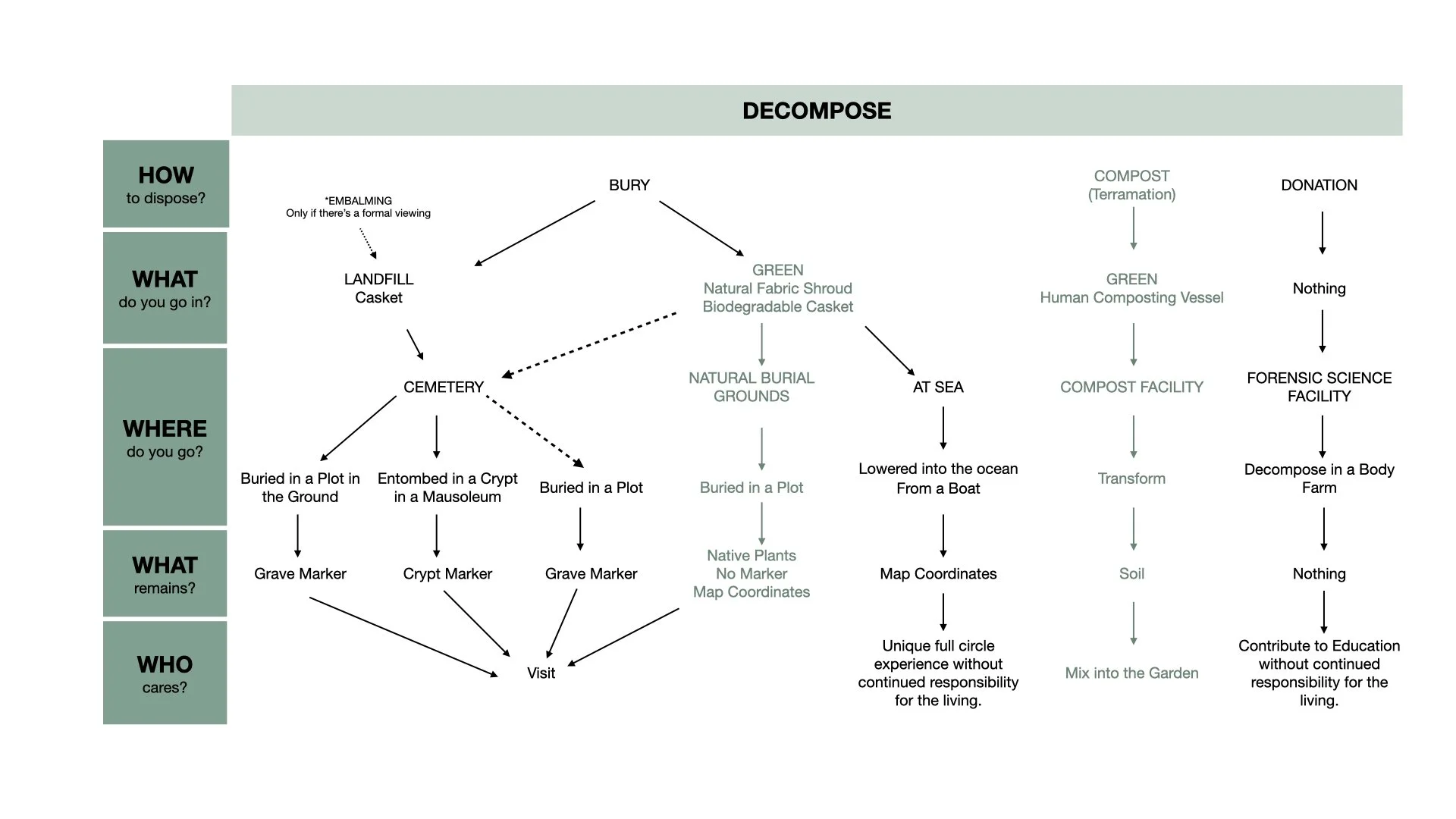
I want their body to decompose…
in a casket buried in a plot in a cemetery marked by a grave marker.
in a casket entombed in a crypt in a mausoleum marked by a nameplate.
in a shroud buried in a natural burial ground marked by a native plant.
in a composting vessel and transformed by terramation into soil used to plant a tree.
in a field at a body farm studied by forensic scientists.
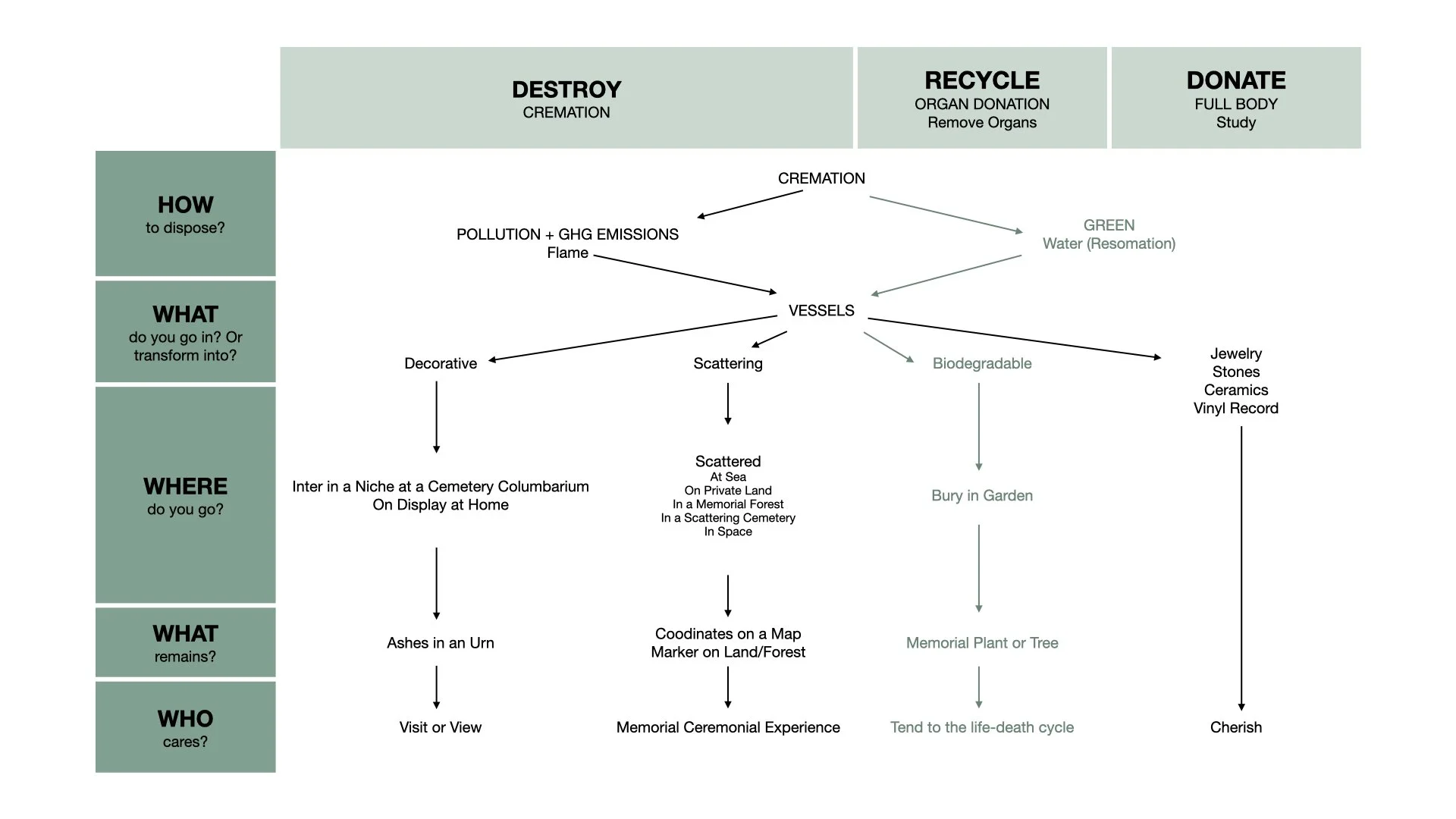
I want their body to be destroyed and turned into ashes …
by flame cremation then scattered at sea.
by water cremation and inurned in a decorative urn displayed in my house.
by flame cremation after their organs are donated then inurned in an urn then interred in a niche in a columbarium at a cemetery.
by water cremation after their donated body is studied for medicine then inurned in a biodegradable urn to be planted in a garden with a tree.
by flame cremation then transformed into a diamond necklace.

Timm Ulrichs
Go Green
TRADITIONAL FUNERALS VS. GREEN FUNERALS
The Green Burial Council defines green burial as service involving no embalming, no concrete vault, no traditional caskets, and little or no human-made changes to the burial site, such as grave markers. It’s an environmental burial, employing "minimal environmental impact,legitimate ecological aims, and a conservation of natural resources."
Traditional is Bad for the Earth
Using chemicals for embalming and materials like concrete and metal that stay in the earth forever is horrible. Green is natural using biodegradable materials so your body can return to earth as it should.
Embalming is Disgusting
Your fluids removed from your body and sent down the drain to a septic system or water treatment plant then are replaced with embalming fluid - a mix of formaldehyde, methanol, dyes, hydrochloric acid, disinfectants, humectants, sulfur dioxide, and benzene.
Cremation
Fire (cremation) vs. water (resomation).
“Ashes” generated from fire cremations are toxic and not bio-degradable. This is a result of the incineration process itself. As such, scattering of these ashes is often restricted or prohibited as their affect on the soil is detrimental and harsh on the surrounding ecology.
Ashes from water cremation are non-toxic, bio-degradable, and beneficial to any environment into which they are incorporated. This allows for a new “no boundaries” approach to scattering choices for families.
GREEN BURIAL COUNCIL
Green burial is a way of caring for the dead with minimal environmental impact that aids in the conservation of natural resources, reduction of carbon emissions, protection of worker health, and the restoration and/or preservation of habitat.
RECOMPOSE
Become soil when you die.
EARTH
Transform into nutrient-rich soil.
ETERNAL REEFS
Memorialize ashes in an eco-friendly marine habitat.
BETTER PLACE FORESTS
Spread ashes around your own memorial tree.
LOOP
Become one with nature in a mycelium living coffins or urn.
HOME FUNERAL ALLIANCE
Sharing all the ways home funerals can look and feel. Support and info to create your own. Community deathcare resource.
FINAL PASSAGES
Conscious dying, home funeral and green burial resources.
Commemoration
BODY OR NOBODY? THAT IS ANOTHER QUESTION.
PRE-SERVICE EVENT
For offering condolences, sharing memories, and supporting the bereaved.
Viewing
A gathering with the body present. It can be in a casket for a burial, a cremation casket for cremation, or just on a display table covered with a blanket. Having the deceased dressed and madeup is a personal choice and normally an additional cost. Can happen anytime before disposition.
Wake
A gathering with the body present, usually religious.
Visitation
A gathering without the body present and more modern.
SERVICE EVENT
Generally formal.
Funeral Service
A formal event where the body is present in a casket or an urn. This could be a service at the funeral home, at the home where the person died (home funeral), at a church, or at the cemetery as part of the committal ceremony.
Memorial Service
A formal event without the body present.
Celebration of Life
A event without the body present with a more lively tone.
COMMITTAL CEREMONY
The final resting place event such as when the body is interred in a grave or crypt, or the inurned ashes are interred in a niche at the cemetery.
Graveside Service
Committal service that happens by the graveside. Usually just opening and closing of the grave.
Scattering Service
Committal service where the ashes are scattered. This is also known as Witnessed Scattering.
SERVICES, CEREMONIES, AND DISPOSITION
Direct Burial
There is no committal service. The burial is done unwitnessed. You could have a service beforehand at a church, funeral home, at home, wherever.
Direct Cremation
There is no service. You can have a memorial service after with the cremation.
Witness Cremation
This is sort of a hybrid of a visitation and direct cremation. The loved ones can witness deceased entering the cremation retort. It’s about a 30 minute event.

Examples
I want my life commemorated with…
a viewing of my body for family, flame cremation soon after, and a celebration of life in a few months at the beach.
a wake, then a church service followed by a committal service graveside at the cemetery the next day.
a direct cremation with a celebration of life in a few months.
a home funeral with a direct burial.
a viewing of my body for family, direct water cremation followed by a memorial service.
a visitation dance party followed by terramation (human composting), and a committal ceremony where the soil that my body transformed into is put into the ground and a plant is placed in it to grow.


HOME FUNERALS
What is a home funeral?
A family centered response to death that allows time to honor the life of the departed and may involve:
Family doing the necessary paperwork
Transportation
Body care
Ceremony
Making caskets, urns, shrouds, etc.
Disposition of the body
Having them lay in honor in the home for one, two or three days
Why have a home funeral?
Emphasizes the family maintaining control in the days following a death.
Offers a beautiful and healing experience for loved ones.
Is often more affordable and respectful to the environment than contemporary funeral industry-led funeral.
The Home Funeral Alliance exists to educate and empower families and communities to care for their own dead. We are a national education organization dedicated to family-led and community-centered deathcare.
Pros
Having some quiet to process has been shown to improve healing from loss. Once you make the call and the body is taken away things start to feel busy.
Cons
Might feel too intense. If so, maybe just sit with the body for an hour then call a funeral home. That’s okay. Do the parts that you can handle.
ETIQUETTE
Attend
Or if you can’t then send a note of condolence.
Arrive on Time
It is disruptive to show up late when the focus should be on the family.
Focus on the Deceased
All conversation should be on memories of the deceased. It’s not time for a personal catchup.
Express Sympathy
If you don’t know what to say, just keep it as “I’m so sorry for your loss.” Less is more.
Use Tech Sparingly
Be low key if you need to check your phone. Put your phone on silence.
Send Food
In compostable/recyclable disposable containers. Ask about food allergies. Deliver with a note. Sign up for meal trains. Better yet, start one.
Sympathy Gift
Flowers to the home or funeral home, or a donation “in lieu of flowers” for the value of flowers to a charity of choice by family.
Stay in Contact
Show support even after all the activity dies down.
Read the Room
Follow the vibe of the family for the level of solemn to celebratory they are feeling.
FUNERAL FLOWERS AND MEANING
Color
Red flowers signify strength, respect, devotion and love.
Blue flowers represent sadness, sympathy and peace.
Orange flowers signify enthusiasm, joy and warmth.
Purple flowers represent respect, sorrow, sympathy and admiration.
Yellow flowers signify friendship, warmth and hope.
Pink flowers represent grace, compassion and innocence.
Green flowers signify nature, wellness and renewal.
White flowers represent elegance, reverence, purity and eternal love
Kind
Daisies signify peace and hope.
Snapdragons represent graciousness and strength.
Lavender signifies grace, purity and devotion.
Tulips represent love, peace and hope.
Orchids signify hope, peace, courage and love.
Gladiolus represent strength and integrity.
Calla lilies signify resurrection and rebirth.
Yellow lilies represent thankfulness.
Iris flowers signify faith, hope, courage, wisdom and admiration.

WRITING A EULOGY
Impact On Others
The coworker they mentored who credits them for their career
The neighbor whose lawn they mowed for years without being asked
The cashier at the grocery store who looked forward to their visits
The server at their regular restaurant who knew their order
The young person they encouraged who never forgot it
The friend who called them first with every piece of news
The student they taught who still thinks of them
The person they helped who never got to say thank you The mail carrier who chatted with them every day for years
The stranger they helped once who never forgot the kindness
Small Acts of Service
How they always drove so others could enjoy a drink at parties
The way they shoveled everyone’s sidewalk, not just their own How they stayed late to help clean up every event
Their willingness to watch pets, kids, or houses without hesitation
The thank-you notes they wrote faithfully How they visited people in the hospital when no one else did
The way they included the person sitting alone
How they brought food when someone was struggling, no request needed
Their habit of picking up litter in the park during walks
The way they always had jumper cables and knew how to use them
What Made Them Laugh
Joy is as important to remember as accomplishment:
What made them laugh so hard they cried
Their sense of humor that not everyone understood
The comedian or show they quoted constantly
What they found funny that they probably should not have
How their laugh sounded, and how it was contagious
Prompts
What did they do every single day?
What would they say right now if they could hear us?
What did you complain about that you would give anything to experience again?
What is a story that makes you smile when you think of them?
What did they teach you without meaning to?
If I had met them at a party, what would they have talked about?
What did they care about that surprised people?
What would be playing at their house right now?
What did they smell like, cologne, sawdust, coffee, garden soil?
What is something they did that nobody else does quite the same way?
Who will miss them that we might not think about?
What ordinary thing did they make special?
How They Made You Feel
How you knew they were listening, their specific way of paying attention
What it felt like to disappoint them
How they made you feel capable of more than you thought
The way they remembered details about your life
How they made strangers feel welcome immediately
What it was like to receive their full attention
How they celebrated other people’s good news
The way they noticed when something was wrong without you saying it
How they made kids feel important and heard
What it felt like to be forgiven by them
How they made you feel safe
The way they showed up when they said they would
How they made ordinary moments feel special
What it was like to laugh with them THow they made you feel less alone
Talents & Skills
How they could fix anything mechanical just by looking at it
Their ability to grow anything, even plants others could not keep alive
How they remembered everyone’s birthday without writing them down
Their talent for making people laugh at exactly the right moment
How they cooked without recipes and it always turned out right
Their ability to parallel park in impossible spaces
How they knew when someone was lying
Their storytelling that made even boring events entertaining
Their skill at packing a car so everything fit perfectly
How they knew exactly what to say in hard moments
Their knack for negotiating or talking their way into anything
How they made friends with anyone within five minutes
Their talent for seeing solutions others missed
How they remembered details from conversations years ago
Daily Rituals
How they took their coffee, and the specific mug they always used
Their morning routine that never varied
What they did every Sunday without fail
The chair that was “theirs,” and how everyone knew not to sit in it
What time they went to bed every night, no matter what
Their newspaper-reading ritual, which sections and in what order
How they said goodbye, a specific phrase, gesture, or tradition
What they wore around the house when no one was coming over
Their grocery shopping routine, same day, same store, same route through the aisles
How they watched TV, commentary, remote habits, favorite spot
Their evening walk route that never changed
What they always had for breakfast
How they answered the phone, their specific greeting
Their bedtime routine that felt sacred
What they did first thing when they got home from work
Things They Always Said
Their response to “How are you?” that was distinctly theirs
What they said when someone was upset
Their go-to advice that they repeated to everyone
How they ended phone conversations
What they said when they were frustrated, their clean curse words
Their catchphrase that everyone could imitate
What they said when someone did something kind
2Their specific way of giving a compliment
What they said when someone was overthinking
Their response to bad news that somehow made it more bearable
How they expressed love if they did not say “I love you” directly
What they said when they were proud but tried not to show it
Their way of deflecting compliments
What they said when they were right and knew it
Their greeting for people they loved
Highly Specific Features
Their specific, sometimes irrational, pet peeves
The way they organized things that made sense only to them
Their weird food combinations or preferences
What they refused to throw away, no matter how broken
Their stubborn insistence on doing things the hard way
How they mispronounced a word and refused to correct it
Their superstitions or rituals that had to be followed
The thing they collected that no one understood
Their opinion on something trivial that they defended passionately
How they wore their clothes, untucked shirts, rolled sleeves, an inside-out lucky tee
Their relationship with technology, and how they talked to it
The food they refused to eat, and why
Their driving habits that made everyone nervous
How they “fixed” things with duct tape and determination
The one song they knew all the words to, and sang badly
OBITUARY
An interview with NY Times obit write Margalit Fox for the Paris Review.
A film about an obit writer starring Shirley MacLaine.
Reading of hilarious obits by Mary McGreevy.
Obits for the famous and dead.
⑤ ADMIN.BIZ
This won’t kill you, but it’s painful.
FIND WILL & DETERMINE EXECUTOR
The executor of a will is the person you name to carry out your wishes after you pass. When you die with a legally-valid will, a judge will approve the executor you’ve named in it to act on it. This could include paying outstanding debts with the money left from your estate, distributing your money and property to your heirs, and more. The deceased survivors need to know where any money, property or belongings will go. Ideally, you talked with your relative before they passed and they told you where they kept their will. If there isn't a will, the probate court judge will name an administrator in place of an executor.
CONTACT ATTORNEY
If there is no will, find an attorney that handles wills and knows probate law. While you don't need an attorney to settle an estate, having one makes things easier.
Probate usually works like this: After your death, the person you named in your will as executor - or, if you die without a will, the person appointed by a judge - files papers in the local probate court. The executor proves the validity of your will and presents the court with lists of your property, your debts, and who is to inherit what you've left. Then, relatives and creditors are officially notified of your death.
TAKE WILL TO PROBATE
Probate is the legal process of executing a will. You'll need to do this at a county or city probate court office. Probate court makes sure that the person's debts and liabilities are paid and that the remaining assets are transferred to the beneficiaries.
ORDER DEATH CERTIFICATES
You’ll need several depending on the size of the estate to close out accounts.
Small 1-3
Medium 5-10
Large 15-20
CONTACT A CPA
If they had a CPA, contact them; if not, hire one. A final tax return will need to be filed on the deceased's behalf.
CONTACT INSURANCE COMPANIES
Fill out life insurance claim. All others just cancel.
SOCIAL SECURITY ADMINISTRATION
If the deceased was receiving Social Security benefits, you need to stop the checks. Funeral directors report deaths to the Social Security Administration, but, ultimately, it's the survivors’ responsibility to tell the SSA. Contact your local SSA office to do so. The agency will let Medicaid know that your loved one died. And if you qualify, apply for survivor benefits
GATHER IMPORTANT DOCS
Will
Military discharge papers
Insurance policies
Citizen papers
Auto title
Property deeds
Marriage license
Income tax returns (last 2 years)
Disability claims
All tax documents (ask accountant)
Financial and bank statements
Retirement, pension, and brokerage accounts
Debt records
Mortgage
Business agreements
Bills
AND MORE TO DO
Contact employer
Contact veterans affairs
Secure the home
Care for plants and pets
Forward mail and save important letters
Cancel subscriptions
Inventory assets
Contact banks, mortgage companies, & financial advisors
Cancel credit cards
Notify reporting companies
Cancel driver’s license
Memorialize social media accounts
Close email accounts
POSESSIONS
Resources for donation, liquidation, charities, estate sales, garage sales, + pets.
CAREER GEAR
Donate professional clothing.
ANGEL GOWN
Provides comfort for bereaved families through the gift of a beautiful custom made gown for final photos and for burial services made from donated wedding gowns.
ONE WARM COAT
Find coat drive locations.
BOOKS TO PRISONERS
Mailing books to incarcerated people since 1973.
EVERYTHING BUT THE HOUSE
Online marketplace.
WE BUY ANY PORN
UK-based company that disposes of your loved one’s stash.
SUPPORT
CHILDREN OF HOARDERS
Crisis cleaning advice. Your parent's living conditions are not, now and never were, your fault.